

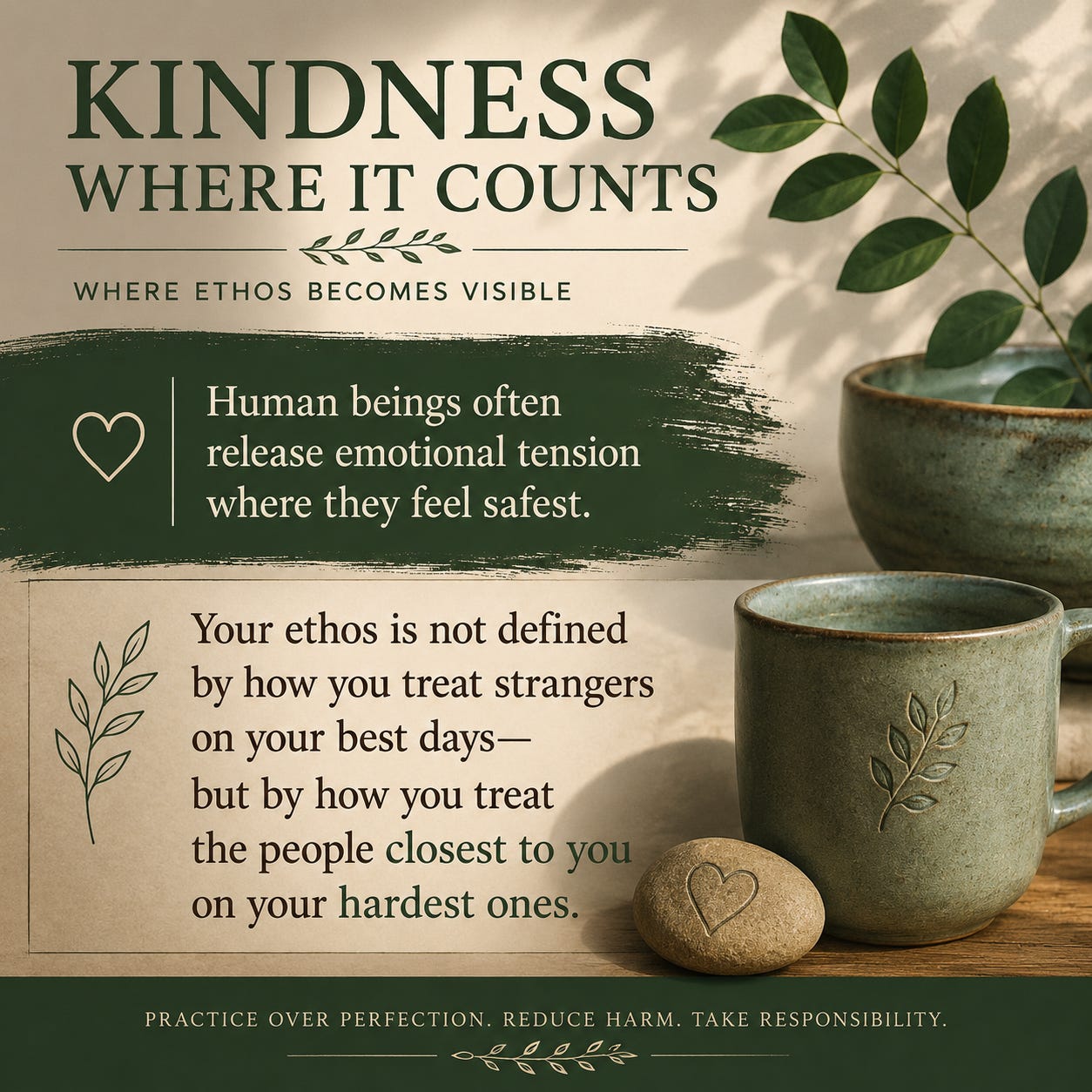
Kindness Where It Counts
Where Ethos Becomes Visible

Most people want to think of themselves as kind.
And often, they are.
To strangers.
To coworkers.
To people they encounter briefly throughout the day.
But close relationships can reveal something different.
Because public kindness means little if cruelty, impatience or disregard dominate our closest relationships.
This is difficult to confront because many people genuinely care about others while simultaneously struggling to extend the same patience, gentleness and awareness to the people nearest to them.
And in many ways, this is deeply human.
The people closest to us often receive the least filtered version of who we are.
Our exhaustion.
Our stress.
Our frustration.
Our emotional history.
Our unresolved fears.
Human beings often release emotional tension where they feel safest.
Not always because they value those people less, but because familiarity lowers the guardrails we maintain in public life.
And over time, something subtle can happen.
The strangers receive politeness, while the people carrying our daily lives alongside us receive impatience.
Dismissiveness.
Emotional absence.
Shortness.
Neglect.
Not always through dramatic cruelty.
It’s actually often through accumulation.
The sigh instead of the conversation.
The distracted response.
The harsh tone.
The lack of listening.
That unspoken assumption that closeness removes the need for care.
But perhaps closeness should invite greater care, not less.
Because ethos becomes most visible where performance disappears.
It is easy to appear compassionate in passing moments.
It is harder to remain compassionate within repetition, stress, familiarity and emotional complexity.
This is where awareness matters.
Not to create shame, but to create honesty.
Because many people are not intentionally trying to harm those they love.
Often, they are overwhelmed.
Disconnected from themselves.
Emotionally exhausted.
Carrying stress they have not slowed down enough to notice.
But awareness still matters, because the impact to those we love matters.
Especially within close relationships.
The people nearest to us often shape:
our nervous systems
our sense of safety
our emotional well-being
our understanding of love, trust and belonging
And repeated moments of impatience, dismissal or emotional carelessness leave impressions over time.
Just as repeated moments of gentleness, listening and compassion do.
This does not mean humans must become endlessly patient or emotionally perfect.
No relationship functions without frustration, mistakes or difficult moments.
But ethical living is not only about how we behave when others are watching.
It is also about how we treat people once familiarity removes performance from the equation.
It is about:
How we speak during stress.
How we respond during conflict.
Whether we listen.
Whether we repair harm after causing it.
Whether the people closest to us consistently experience care alongside our humanity.
Because kindness is not measured only by public image.
Sometimes it is measured quietly in kitchens, living rooms, phone calls and ordinary daily interactions no one else sees.
And perhaps one of the clearest reflections of ethos is not how warmly we treat strangers for a moment, but how intentionally we care for the people walking beside us over time.
—
Because the way we practice being human shapes the kind of humans we become.
Subscribe to join this ongoing practice in becoming more aware, more thoughtful and more human.